
Planting a Living Willow Structure
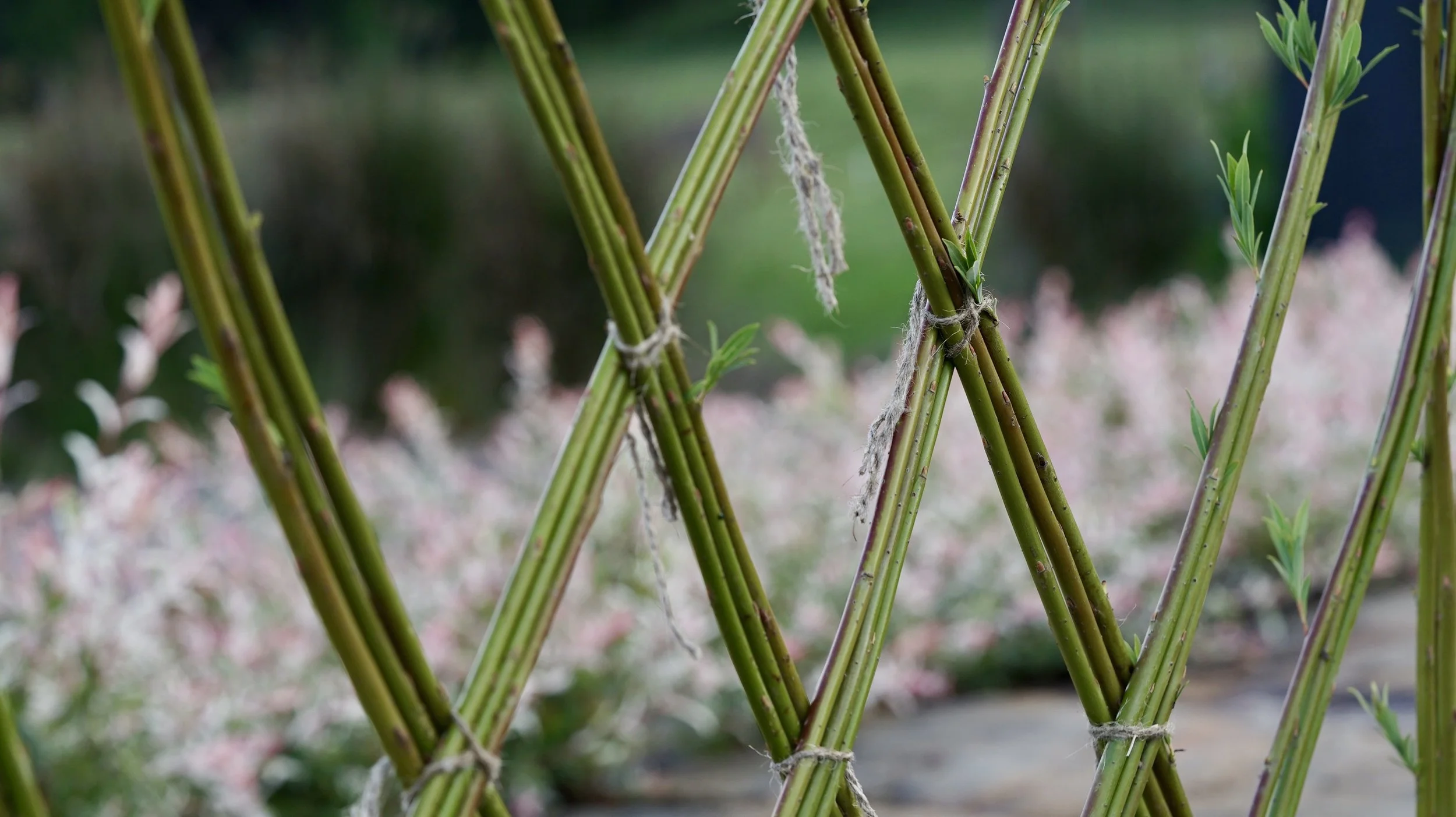
Basic Design of Most Woven Willow Structures
How to Plan & Plant a Living Willow Structure
There are many good reasons to plant a willow structure. They provide shelter for various wildlife species, as the dense growth is very attractive to birds. Varieties with catkins provide an early season food source for pollinators. Willow fences can function as a natural windbreaks, and help to buffer sound from the outside surroundings. Also, willows are known for their ability to improve soil health. Their extensive root systems stabilize the soil, prevent erosion, and help retain moisture. This makes them ideal for areas prone to flooding or poor drainage. (And is also the reason that you should never plant willow near underground plumbing.) If you are thinking of planting a willow structure or fence, here are some things that you’ll need to consider…
Willow Hedges or “Fedges”
If you plant regular size cuttings, you will grow a hedge, as the growth will always be coming from the bottom, near the ground. It could be possible to train this hedge into a loosely woven fence, but it will not be tidy, and will take years to achieve the effect. There is nothing wrong with having a willow hedge. It’s beautiful, and all of the benefits to wildlife are the same. If you want a lower, fuller screen, it may be the best choice for you, too. A single row of most varieties of willow will provide a decent screen, but two rows planted in a staggered pattern will obviously be denser, and will also allow you to alternate pruning years, so that you always have something there. Coppice one row one year, leaving the other intact, and the following year, do the opposite. If you’re feeling crazy, go for three! There is no reason that your willow fedge has to be a single variety, either. A mixture can be especially beautiful in the fall, and remember, your fedge is producing useable willow rods and stems for anything that you can dream to do with them! Want willow rods to weave with? Baskets, garden structures, material for a woven fence elsewhere on your property? Maybe bundles of colorful pussy willow stems to decorate with every year? Willow provides all those things!
Woven Willow Fences, Huts, and Other Structures
If you want a woven willow fence, or other willow structure, it is necessary to plant long rods to weave into your chosen design. The new growth will then come mostly from the tops, and you will cut off the small side shoots that emerge, to preserve your design.
Length of Rods to Use: Keep in mind that you will want to have about 8”-12” of the rod planted into the ground, and then have enough rod above ground to create the desired height with the rods angled for the pattern. Your rods will need to be about 2’ longer than your fence will be tall. When choosing the variety of willow to use, If you’re keen on feeding pollinators, then a variety that produces large catkins is key. Remember that you can harvest from the top growth of a woven fence, so if you’d like to do so, plant the variety that you want to harvest.
Site Prep: Whether you’re planting a fedge or a woven fence, the prep will be the same. The planting area should be free of grass and weeds and in a place where it will get plenty of sunlight. If weed competition is high, landscape fabric or cardboard and a thick layer of mulch will greatly increase the chances of a healthy establishment of your willow. As to the water supply, wet or poorly drained area is great, but willow doesn’t like standing water all year round. If your area isn’t wet, know that you’ll need to water the willow faithfully throughout the first year, and in subsequent years if conditions become very dry. A soaker hose or drip line run the length of the fence is a good idea.
Variety to Use: Almost any variety of willow will work, but foliage, winter color, catkins or no, and deer resistance are factors to consider. If you are planting a tall fence, arch, hut, or other tall structure, you will need a willow that produces longer rods. The miyabeanas are the largest that we offer, (‘Dave’s Green’) is our go-to, and Rubykins has beautiful foliage and small catkins, and is probably not tall enough for a hut, but would work for a fence or smaller arch. Blue Streak is absolutely gorgeous, and while its relatively sparse growth would make a puny hedge, it would be a beautiful, lower-maintenance fence or arch. These are just a couple of our favorites, but there are many good choices. If choosing your variety based on fall color, keep in mind that the color is mostly on new growth, which will be at the top, and the lower, woven portion of your structure will grow barky in time, and lose its distinctive color. If you have deer pressure, and are planting a structure low enough for the leaves to be in reach, you’ll want to choose a deer resistant variety.
Planting: Planting is pretty straightforward. Mark spots approximately 12” apart (you can go narrower or wider-your call) Use a poker to make pilot holes at the appropriate angles, and stick the willow in about 8’-12’ deep. Weave the rods behind, in front, behind, in front. Tie the intersections together with something that has some give, or will break down over time. The willow needs to be bound together in order to graft, but you don’t want it to be strangled as it grows. Pay attention to keeping the tied intersections on parallel planes to the ground. If you are planting a fence, and it is very long, you will probably need some vertical supports interspersed. If you are making a hut or arch, pull the tops together and tie them. It is ok if the willow doesn’t quite meet at at the top. You can pull it together as it grows. Rods that extend past your border or doorway can be gently wrapped around the end post. Remember that it’s organic, it will grow and fill out, and anything that looks wonky will probably be hidden over time. Don’t stress about it!
Maintenance: As your fence grows, small leaves and shoots will pop out along the lengths of the rods. Pluck these off or they will grow into branches that muss up your design. Top growth can be woven together horozontally across the top if you like, and then, after the first growing season, can be trimmed. Don’t cut it in its first season.
I’m sure that there will be questions, and I am happy to answer. Characteristics of different varieties, along with their deer resistance, are noted in the descriptions of our “Shop Willow” page. Please no comments on my artwork, I am well aware that I am not gifted in that area, lol!
Cost: Full length rods range from $5-$8 each, depending on length and diameter. Using this range, a 10’ section of living fence will run $100-$160 for a single rod weave, and $200-$320 for a paired rod weave. If using willow for upright supports (fence posts), that will need to be factored in as well.
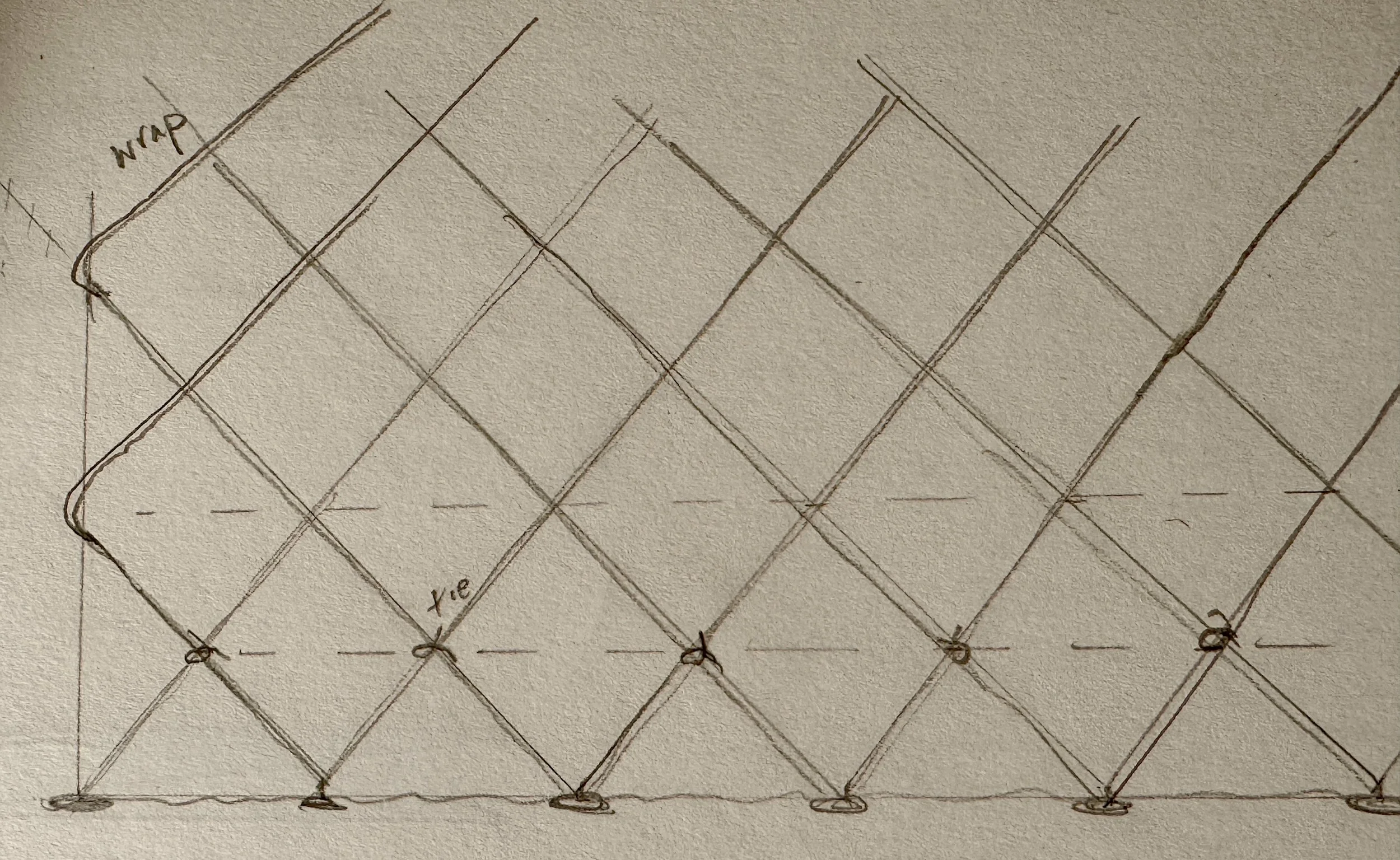
Keep the intersections level. For a hut, just do this in a circle!